festival tours
The Lunar New Year celebration, Tsagaan Sar
13 days / 12 nights
2800 EUR per person
1600
track 50%
comfortable
Gobi Desert and Central Mongolia
Lunar New Year Festival, Tsagaan Sar 13/02-23/02 2026
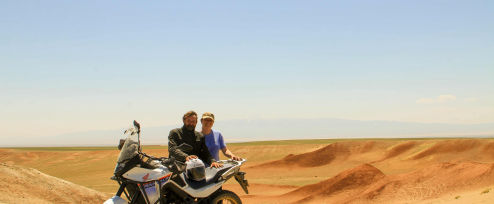
The Gobi Desert is one of the most exciting destinations to visit in Mongolia. You will admire extremely isolated landscapes with no one else around for hundreds of kilometres except for a few nomadic families. You will enjoy a combination of large sand dunes, rocky mountains with ancient canyons, and vast forests of small saxaul trees. The Gobi is the fifth largest desert in the world and is home to many animals such as antelopes and Bactrian camels. The highest part of the Gobi is 1,580 metres above sea level and covers an area of over 1.2 million km2, a true paradise for enduro riding. The first fossilised dinosaur eggs were discovered in Bayanzag, where you will probably experience one of the most beautiful sunrises you have ever seen. You will have an unforgettable experience.
Price per person
2-3 3,400 euros
4-6 3,200 euros
7-9 3,000 euros
10 2,800 euros
Snowmobile or CRF250l
Jour 1
Arrival in Ulaanbaatar
Reception at the airport and transfer to the hotel. Free visit of the city.
Jour 2
Ulaanbaatar-Mini Gobi300 km
290 km on asphalt road
10 km on slightly sandy track
Discover wonderful landscapes: the magnificent and impressive rock formations of Khogno Khan, the semi-desert steppes, the taiga and the 80 km long sand fracture. This place is called ‘the Mini-Gobi’. It is a rare natural creation in the form of sand dunes in the steppe. It is a landscape that is difficult to find elsewhere. The undulating sands, which can reach 7 km wide and 80 km long, stretch from north to south. The Tarnyn Gol River flows below, contributing to the abundant growth of vegetation on the dunes. It originates in the Khogno Khan massif, just a few kilometres from the dunes. This relatively low granite massif, which can reach 1,967 m, is home to a wide variety of animals, birds and mammals. The sand dunes are stunning against the backdrop of the surrounding mountain ranges and steppes. The region's unique ecosystem and picturesque landscape attract tourists.
There is the opportunity to walk among the small dunes.
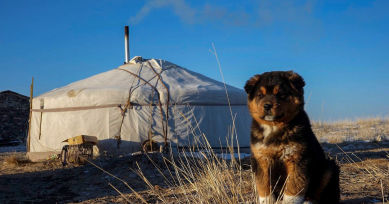
Overnight stay with a nomadic family in a yurt.
Jour 3
Mini Gobi – Arvaikheer (capital of the Uvurkhangai region) 150 km
130 km on asphalt road
20 km on slightly sandy track
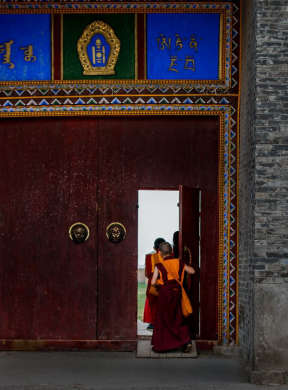
Morning: Visit to a small monastery in the sacred Khugnu Khan mountain.
After visiting the monastery, you will drive to the town of Arvaikheer.
Overnight stay at a hotel.
Jour 4
Arvaikheer – Baruun Bayan Ulaan 180 km
90 km on the track
90 km on the road
Visit to the statue of the region's fast horses.
Arrival in the Gobi Desert, in the small village of Baruun Bayan Ulaan.
Baruunbayan-Ulaan was founded in 1924 and is the oldest noble in the province of Sain Noyon Khan. The total area is 394,111 ha. Population: 2,988. In the south-western part of Uvurkhangai Province:
The physical geography is an extension of the Mongolian Altai Range, along the Lower Bogd Mountains and the Arctic Bogd Mountains, on the south and west sides of the hills, generally facing south towards the slopes, the valley between the mountains and the strong winds. The soums are suitable for livestock farming, tourism and cultivation. Winters are dry and cold.
Overnight stay with a nomadic family in a yurt
Jour 5
New Year's Eve party10 km
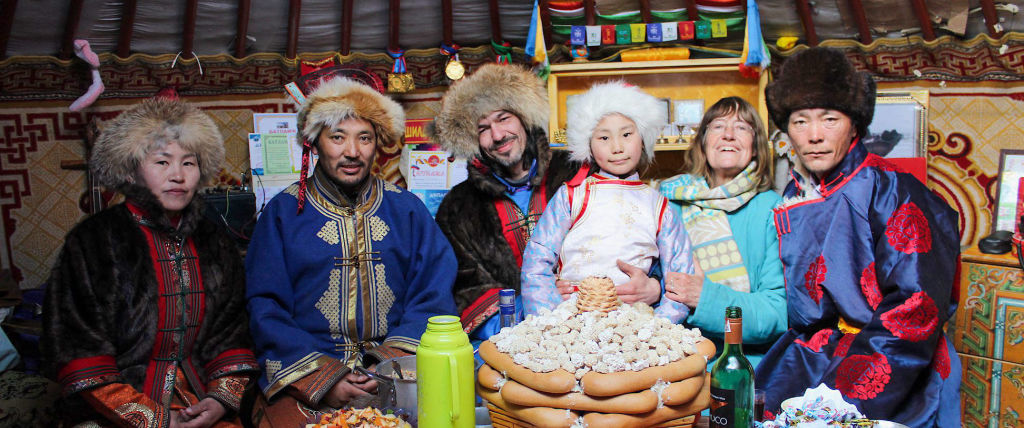
Tsagaan Sar, the Mongolian Lunar New Year, is a much-loved holiday that marks the arrival of spring and the renewal of life. Celebrated according to the lunar calendar, it is an opportunity for families and loved ones to gather, express their respect for their elders, and share their wishes for prosperity and happiness in the coming year.
Bituun (Tsagaan Sar Eve): Preparations begin with thorough cleaning and the preparation of traditional dishes such as buuz (steamed dumplings), bansh (small dumplings), tsagaalga (a dish made from dairy products) and the impressive ul boov (stacked biscuits), symbolising abundance. Families also settle their debts and resolve their conflicts in order to make a fresh start for the new year.
Night with a nomadic family
Jour 6
New Year's celebration10 km
Mongolian Lunar New Year
Greeting rituals: on the first day, the youngest members of the family visit their elders, greeting them with the traditional ‘Amar mend uu?’ (Are you living in peace?) and offering them khadags (ceremonial scarves) as a sign of respect. The tables are laden with traditional dishes, including airag (fermented mare's milk) and various dairy products. Over the following days, families continue to visit their relatives and friends, exchanging gifts and good wishes.
Participation in activities The Mongolian Lunar New Year Festival
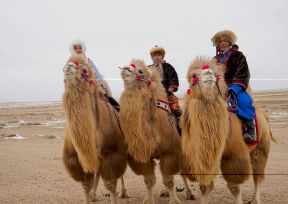
Afternoon walk in the dunes, with the option of riding camels.
Overnight stay with a nomadic family
Jour 7
Baruunbayan-Ulaan-Arvaikheer180 km
Nuit à l’hôtel.
Jour 8
Arvaikheer—The Orkhon Valley 152 km
Orkhon Valley National Park is located in central Mongolia, in the provinces of Uvurkhangai and Arkhangai, 360 kilometres south-west of the city of Ulaanbaatar. The park was established in 2006 to protect the unique ecosystems and biodiversity of the Orkhon Valley and to preserve the ancient, historical and cultural monuments of the valley, which was inscribed on the UNESCO World Heritage List as the Orkhon Valley Cultural Landscape in 2004. It covers an area of 365,000 hectares and its landscape consists of the eastern part of the Khangai mountain range, mountain forests and forest-steppes. The park is home to 417 plant species, including 28 rare or endangered species, 48 mammal species, 278 bird species and 22 fish species.
Since prehistoric times, the Orkhon Valley has been inhabited by nomadic tribes. Archaeological excavations suggest that the region was already inhabited 60,000 years ago by tribes of Huns, Turks, Uyghurs, Kidans and, finally, Mongols. According to UNESCO, the region ‘represents the evolution of a nomadic pastoral civilisation over two thousand years’. For centuries, the Orkhon Valley served as a crossroads of civilisations, connecting East and West and being the political, commercial, cultural and religious centre of nomadic empires, including the Mongol Empire.Among the historical and cultural monuments located in the Orkhon Valley are the ruins of Karakorum - the capital of the Mongol Empire (13th century), the Buddhist monastery Erdene-Zuu, etc. The Orkhon Valley National Park is also famous for its natural attractions - the Mogoit hot springs and the Ulaan-Tsutgalan waterfall (Orkhon waterfall).
Beautiful landscapes: mountains, forests and volcanic rocks.
Overnight stay with a nomadic family.
Jour 9
A day with the nomadic family 22 km
Visit to the Orkhon Waterfall - 22 km
Option to take a walk in yak country.
Option to go horse riding.
Option to participate in the daily activities of nomads: milking yaks and mares, cooking, etc.
Overnight stay with a nomadic family.
Jour 10
The Orkhon Valley-Karakorum120 km
120 km on the trail
Karakorum, the ancient capital of the Mongols
The city of Karakorum is located in central Mongolia, north of the province of Uverkhangai, in the Orkhon River valley. In 2004, Karakorum was inscribed on the UNESCO World Heritage List as part of the Orkhon Valley cultural landscape. The main attractions of Karakorum are the ruins of the ancient city of Karakorum, founded by Genghis Khan in 1220, and the Erdene-Zuu Monastery, the oldest Buddhist monastery in Mongolia. You will see the new urban development and the ruins of the old city, of which only the remains of the walls, the foundations of the Great Khan's palace, an irrigation canal, several columns and two statues of huge stone turtles remain - originally, there were four tortoises, on whose backs stone steles were placed, and they were placed at the four corners of ancient Karakorum. Today, Karakorum is a small town with a population of about 9,000. The town has several banks, hotels, restaurants and cafés. In June 2011, the Karakorum Museum was officially opened, with an exhibition of archaeological finds from the ruins of Karakorum and the Orkhon River valley. Karakorum's main sources of income are agriculture and tourism.
Afternoon: Visit Karakorum, the ancient capital of the Mongol Empire, founded in 1220.
Visit Erdene Zuu Monastery (dating from the 16th century).
Visit the Karakorum Museum (built in 2011).
Overnight stay at the tourist camp.
Jour 11
Karakorum-Ulaanbaatar 370 km
370 km on asphalt roads
Shopping, visit to the cashmere factory, free day
Overnight stay at a hotel
Jour 12
Equestrian statues of Genghis Khan130 km
Built in 2008, the 40-metre-high complex of equestrian statues of Genghis Khan (Chinggis Khan) in Tsonjun Boldog has quickly become one of Mongolia's must-see attractions. The imposing statue on the banks of the Tuul River, with Terelj National Park in the background, offers a majestic setting and a sight not to be missed.
Genghis Khan on horseback currently holds the record for the tallest equestrian statue in the world. Visitors can climb to the top of the horse's head to get a closer look at the khan himself and admire the beautiful landscape of Tsonjin Boldog and the Tuul River.
At the foot of the statue, you will find the visitor centre, which houses a huge two-storey traditional Mongolian boot, a 5-metre sword, an archaeological museum, a small souvenir shop and a restaurant.
Jour 13
Last day50 km
Transfer to the airport
Included
Airport transfer
2 nights hotel accommodation in Ulaanbaatar
All meals during the trip in the countryside
The last dinner in Ulaanbaatar
All visits (museum, monastery…)
Yurt camp costs
Entrance fees to the national park
All road taxes
1 guide, 1 mechanic, 1 assistant
Motorbike rental, HONDA CRF250L
Gasoline
Bottled water
Not included
Flight costs
Cost of the visa
Insurance
Meals in Ulaanbaatar