Hybrid Circuit
The Orkhon Valley and the Altai Mountains
20 days / 19 nights
3600 EUR per person
5019
track 60, asphalt road 40%
comfortable
7 days on a motorcycle to experience the freedom of the open road, the adrenaline rush, and the thrill of exploring wide open spaces.
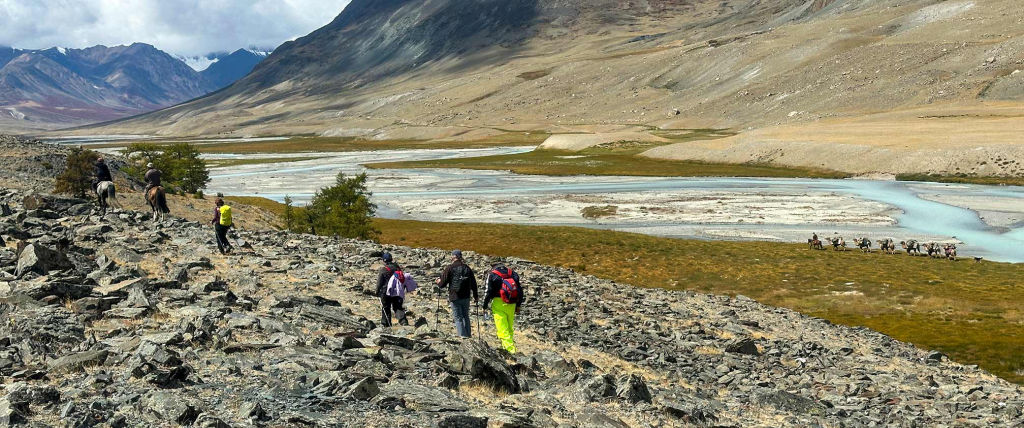
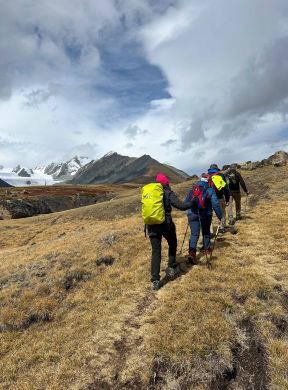
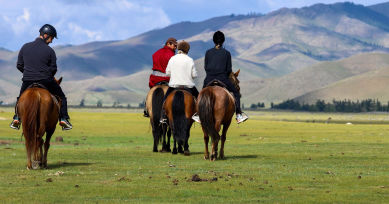
7 days on foot or horseback to immerse yourself in nature, experience authenticity, and reconnect with local traditions.
This hybrid trip combines speed and discovery, modernity and authenticity. An unforgettable experience for adventure enthusiasts who want to experience it all in a single tour.
2-3 riders - €4,200
4-6 riders - €4,000
7-9 riders - €3,800
10 riders - €3,600
For passengers: between €2,600 and €3,200
There is a 5% discount for families.
Low season discount of 5% per person in May and September.
Low, lightweight YAMAHA TW225 motorcycles for women.
Honda Transalp XL 750, XL700V For traveling as a couple.
Jour 1
Arrival in Ulaanbaatar
Welcome at the airport and transfer to the hotel. Free visit of the city.
Jour 2
Ulan Bator - Mini Gobi310 km km
290 km on the asphalt road
20 km on a sandy track
Discover the wonderful landscapes: the impressive rock formations of Khogno Khan, the semi-desert steppes, the taiga and the 80 km long sandy break. This place is called "the Mini - Gobi". It is a rare creation of nature, in the form of sand dunes in the steppe. It is a landscape that can hardly be found elsewhere. The undulating sands, which can be up to 7 km wide and 80 km long, stretch from north to south. The Tarnyn Gol River flows beneath it, contributing to the abundant vegetation growth on the dunes. It originates in the Khogno Khan massif, only a few kilometres from the dunes. This relatively low granite massif, which can reach up to 1967m, is home to a wide variety of animals, birds and mammals. The sand dunes are stunning against the backdrop of the surrounding mountain ranges and steppes. The unique ecosystem and the picturesque landscape of the area attract tourists.
Night in the tourist camp
Jour 3
Mini-gobi Karakorum100 km
80 km on the asphalt road
20 km on a sandy track
Karakorum, the ancient capital of the Mongols
The city of Karakorum is located in central Mongolia, in the north of Uverkhangai province, in the valley of the Orkhon River. In 2004, Karakorum was inscribed on the UNESCO World Heritage List as part of the Orkhon Valley cultural landscape. The main attractions of Karakorum are the ruins of the ancient city of Karakorum, founded by Genghis Khan in 1220, and the Erdene-Zuu Monastery, the oldest Buddhist monastery in Mongolia. You will see the new urban development and the ruins of the old city, of which only the remains of the walls, the foundations of the Great Khan's palace, an irrigation canal, several columns and two statues of huge stone turtles - originally there were four turtles, on whose backs stone steles were placed, and they were placed at the four corners of the old Karakorum. Today, Karakorum is a small town of about 9000 inhabitants. The town has several banks, hotels, restaurants and cafes. In June 2011, the Karakorum Museum was officially opened, with an exhibition of archaeological finds from the ruins of Karakorum and the Orkhon River valley. Karakorum's main sources of income are agriculture and tourism.
Visit Karakorum, the former capital of the Mongol Empire, founded in 1220.
Visit of the Erdene Zuu monastery (dating from the 16th century)
Visit of the Karakorum museum (built in 2011)
Overnight at the tourist camp
Jour 4
Karakorum - Orkhon Valley120km km
100% on the track
Crossing small rivers and streams
Orkhon Valley National Park is located in central Mongolia, in the provinces of Uvurkhangai and Arkhangai, 360 kilometres southwest of the city of Ulaanbaatar. The park was established in 2006 to protect the unique ecosystems and biodiversity of the Orkhon Valley, and to preserve the ancient, historical and cultural monuments of the valley, which was inscribed on the UNESCO World Heritage List as the Orkhon Valley Cultural Landscape in 2004. It has an area of 365,000 hectares and its landscape consists of the eastern part of the Khangai mountain range, mountain forests and steppe forests. The park has 417 plant species, including 28 rare or endangered species and 48 mammal species, 278 bird species, 22 fish species.
. The Orkhon Valley has been inhabited by nomadic tribes since prehistoric times. Archaeological excavations suggest that the region was already inhabited 60,000 years ago by tribes of Huns, Turks, Uyghurs, Kidans and, finally, Mongols. According to UNESCO, the region "represents the evolution of a nomadic pastoral civilisation over two thousand years". For centuries, the Orkhon Valley served as a crossroads of civilizations, linking East and West and being the political, commercial, cultural and religious centre of nomadic empires, including the Mongolian Empire. Among the historical and cultural monuments located in the Orkhon Valley are the ruins of Karakorum - the capital of the Mongol Empire (13th century), the Erde-Zuu Buddhist monastery etc. The Orkhon Valley National Park is also famous for its natural attractions - the Mogoit hot springs, the Ulaan-Tsutgalan waterfall (Orkhon waterfall).
Night with a nomadic family in a yurt
Jour 5
Orkhon vallee12 km
Visit to the Orkhon waterfall.
Option to take a walk in yak country.
Option to go horseback riding.
Option to participate in the daily activities of nomads: milking yaks and mares, cooking, etc.
Overnight stay with a nomadic family in a yur
Jour 6
Orkhon Valley - Tsenkher Hot Spring120 km
100% on track
The Tsenkher hot springs are located in central Mongolia, in Arkhangai Province, 24 kilometers south of the village of Tsenkher. The valley where the hot springs are located is 1,860 meters above sea level, surrounded by mountains whose slopes are covered with dense larch forest. Thousands of years ago, the region was subject to seismic activity, and today, the cones of extinct volcanoes and hot mineral springs gushing from the ground are the only evidence of this. The hot springs of Tsenkher have medicinal properties, the water has a temperature of 85.5°C and contains hydrogen sulfide, sodium carbonate, calcium fluoride, hydrocarbonates, and sulfates. The healing properties of the Tsenkher springs have been known for a long time, and locals use them to treat diseases of the musculoskeletal system, skin, digestive organs, nervous system, and diabetes. Several tourist camps with outdoor and indoor pools have been built near the spring, with water coming directly from the hot spring.
Overnight stay at the tourist camp.
Jour 7
Tsenkher Hot Spring - Lake Ugii160 km
100% on track
Lake Ugii Nuur is located in central Mongolia, in Arkhangai Province, in Ugii Nuur Sum. The lake lies 1,337 meters above sea level, with a water surface area of 25 square kilometers and a maximum depth of 15 meters. The lake is freshwater and is connected to the Orkhon River by a canal. The lake's shores are flat, with sandy and pebble beaches. The lake is included in the Ramsar Convention program for the protection of wetlands of international importance because Ugii Nuur is a breeding ground for 150 migratory water birds (great blue heron, whooper swan, cranes, ducks, geese, spoonbills, Dalmatian pelican, etc.). The lake is renowned for its excellent fishing, with 14 species of fish (pike, perch, carp, burbot, stone loach, red mullet, lenok).
Overnight stay at the tourist camp
Jour 8
Lake Ugii - Ulaanbaatar340 km
305 km on paved roads
35 km on trails
Overnight stay at a hotel
Jour 9
Ulaanbaatar-Khovd domestic flight 1466 km
Khovd, capital of the province of the same name, located 1,500 km from Ulaanbaatar.
Khovd was an important trading center located north of the Silk Road, which had forged links with
Russia and China. In 1763, the Manchu administration built the Sangiin Kherem fortress. Walls
3 meters high and 2 meters wide enclosed the city, which covered an area of 4 hectares. Today, the
province of Khovd is home to 18 Mongolian ethnic groups.
Olgii
The westernmost provincial capital of Mongolia, which is also the most remote place in the world from the
oceans. Olgii is located 1,636 km from Ulaanbaatar, at an altitude of 1,710 meters. It is mainly populated by
Kazakhs, and its atmosphere is heavily influenced by Central Asia: there are many signs written in Arabic,
and mosques with domes pointing skyward.
Overnight at the hotel.
Jour 10
Altai Tavan Bogd National Park 220 km
Altai Tavan Bogd National Park, the “five sacred mountains of Altai,” covers an area of 6,362 km² in
the extreme southwest of Mongolia, bordering China and Russia. Mount Khuiten is the
highest peak in the range and in Mongolia, at 4,374 meters above sea level. It was first climbed
by a Mongolian expedition in 1956.
Altai Tavan Bogd is a high mountain area with numerous glaciers. Ninety-six percent of Mongolia's glacial rivers
are located in Altai Tavan Bogd. The most accessible glacier is Potanine, which can be climbed without technical equipment, but requires physical fitness, as part of a hike in the
park.
Mountaineering enthusiasts will also find what they are looking for with the ascent of Malchin, “the mountain of the herder” (4,037 meters), and Nairamdal, “the mountain of the hunter” (4,037 meters). Mountaineering enthusiasts will also find what they are looking for with the ascent of Malchin, "mountain of the
herder“ (4,037 meters), Nairamdal, ”mountain of friendship“ (4,082 meters), and Khuiten, ”cold mountain" (4,374
meters). The other two peaks forming the Tavan Bogd are Burged (4,068 meters) and Ölgii (4,050
meters). South of these high mountains, the park extends over a medium-altitude area, between
2,000 and 3,000 meters above sea level, accessible to hikers in good physical condition who are
accustomed to walking in the mountains. There are forests of Siberian pine and larch, as well as numerous lakes: Khoton, Khurgan, Dayan, Khovd, Khar Salaa, Tsagaan Salaa, Songinot, and Lake
Yolt. The national park is home to many animal species such as argali sheep, Siberian ibex, red deer, martens, elk, black grouse, and golden eagles.
The Mongolian Altai petroglyphs, a UNESCO World Heritage Site, are also located
in the national park.
Three sites are listed, comprising several thousand rock paintings and Turkic monoliths, including the rock paintings of Tsagaan Salaa, where it is possible to observe Three sites are listed, comprising several thousand rock paintings and
Turkic monoliths, including the rock paintings of Tsagaan Salaa, where more than
10,000 drawings can be seen across 15 km of valley.
Night with nomads
Jour 11
Potanine Glacier21 km
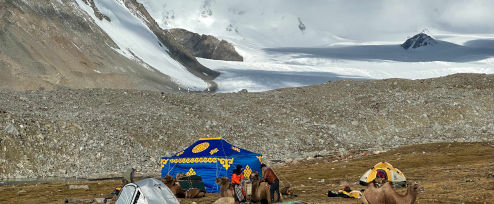
The Potanine Glacier is located on the Tavan Bogd massif in the Altai Mountains of Mongolia. It is the largest glacier
in Mongolia, measuring approximately 14 kilometers in length.
Overnight in tents.
Jour 12
White River20 km
The Milk River, or Tsagaan River, originates in the Altai Tavan Bogd mountain range in Bayan Olgii province
and flows for 111 km before emptying into the Hovd River.
Three of Mongolia's largest glaciers, the Alexander, Graneg, and Potanin glaciers, are the source of the
Tsagaan River's runoff. These rivers melt in summer to create the white color of this geologically unique
white mountain clay sediment. This is why the local population respectfully calls
the lake the Milk River.
Night in a tent.
Jour 13
Takhilt Pass 3622m20 km
After crossing the Takhilt Pass, we begin a long descent into a completely different landscape
. The Bear Valley is home to abundant wildlife: ibex, Himalayan brown bears, wolves, and red deer.
The region is partially wooded (the other valleys are treeless) and the autumn foliage
should be at its peak at this time of year.
Night in tents.
Jour 14
The Bear Valley20 km
The Bear Valley is the most amazing and spectacular place with fantastic landscapes,
surrounded by green snow-capped mountains with several waterfalls and crystal clear lakes located in the
southwest of the Altai Tavan Bogd National Park. This place is not accessible by jeeps or
transportation, as there is no special road to get there. But during the early years of
nomadism, people used this valley as a shortcut between their winter and summer homes when they
migrated with packed camels and all their livestock.
Night in a tent
Jour 15
Lake Khoton20 km
Lake Khoton, connected to Lake Khurgan, is nestled among peaks at an altitude of 2,080 meters,
north of the Altai mountain range. The high snow-capped peaks and surrounding moraines
cover an area of 1,341 km². The lake covers an area of 50 km² with an average depth
of 26 meters. In autumn, the lake freezes to a thickness of 1.7 meters. In winter,
the green and gray tones of the lake contrast with the sublime winter scenery. It is only late in the spring that
the waters from the melting ice and 10 rivers such as Chuluut, Zagastai, and the Black Khovd come to
feed the lake. A small island emerges from the lake, home to a forest of trees and bushes. A
dense forest runs along the shores of the lake, providing a habitat for various species of birds. The lake is
an ideal place for fishing due to the abundance of fish in its crystal clear waters.
Night with nomads
Jour 16
Turgen Waterfall20 km
Située dans la chaîne de montagnes Turgen Uul, la cascade Baga Turgenii Khurkhree, haute de 36 mètres, est
divisée en deux parties. La première partie mesure 23 mètres et la seconde 13 mètres. La rivière Turgen
prend sa source dans la fonte des neiges glaciaires.
Nuit chez nomad
Jour 17
Turgen Waterfall-Ulgii180 km
Nous retrouvons la piste, difficile à cet endroit, qui nous ramène sur la capitale de la
province : Olgii.
Nuit à l’hôtel
Jour 18
Domestic flight Ulgii-Ulaanbaatar1640 km
Arrival in Ulaanbaatar
Shopping, visit to the cashmere factory, free day
Overnight stay at the hotel
Jour 19
Equestrian statues of Genghis Khan130 km
Built in 2008, the 40-meter-high complex of equestrian statues of Genghis Khan (Chinggis Khan) in Tsonjun Boldog has quickly become one of Mongolia's must-see attractions. The imposing statue on the banks of the Tuul River, with Terelj National Park in the background, offers a majestic setting and a sight not to be missed.
Genghis Khan on horseback currently holds the record for the tallest equestrian statue in the world. Visitors can climb to the top of the horse's head to get a closer look at the khan himself and admire the beautiful landscape of Tsonjin Boldog and the Tuul River.
At the foot of the statue, you will find the visitor center, which houses a huge two-story traditional Mongolian boot, a 5-meter sword, an archaeological museum, a small souvenir shop, and a restaurant.
Jour 20
Last day50 km
Airport transfer
Included
Airport transfer
2 nights hotel accommodation in Ulaanbaatar
All meals during the trip in the countryside
The last dinner in Ulaanbaatar
All visits (museum, monastery…)
Yurt camp costs
Entrance fees to the national park
All road taxes
1 guide, 1 mechanic, 1 assistant
Hire of HONDA CRF250L, YAMAHA TW 225, XL750
Gasoline
Bottled water
Not included
Flight costs
Cost of the visa
Insurance
Meals in Ulaanbaatar