Adventure tours
The Great Loop of Mongolia
20 days / 19 nights
3600 EUR per person
3562
track 70%, asphalt road 30%.
comfortable
2-3 riders - €4,200
4-6 riders - €4,000
7-9 riders - €3,800
10 riders - €3,600
For passengers: between €2,600 and €3,200
There is a 5% discount for families.
Low season discounts of 5% per person in May and September.
Low, lightweight YAMAHA TW225 motorcycles for women.
Honda Transalp XL 750, XL700V For traveling as a couple.
Jour 1
Arrival in Ulaanbaatar50 km
Reception at the airport and transfer to the hotel. Free visit of the city.
Jour 2
The granite formations of Baga Gazriin Chuluu240 km
The granite formations of Baga Gazriin Chuluu
• Visit to the Baga Gazriin Chuluu mountains, where we will observe impressive granite rock formations eroded by the often violent elements of this region. In the 19th century, two revered monks lived here, and their inscriptions in the rock can be seen.
• Overnight stay in a tourist camp
Jour 3
Baga gazar-White Stupa240 km
• White Stupa is a steep 30-meter-high mountain shaped like a stupa, revered for centuries by the Mongols. Travelers will be amazed by these magnificent lunar landscapes, reminiscent of the end of the world, and by the numerous fossils found in this region, which was covered by the sea millions of years ago.
• Overnight stay with a nomadic family
Jour 4
White Stupa – Yoliin am Canyon 180 km
• Yol Canyon translates into English as the canyon of bearded vultures. You can walk along the bottom of the canyon, which is covered with a blanket of eternal ice. It is so steep that the sun's rays only manage to melt the ice that covers the canyon for the rest of the year from August onwards.
• Overnight stay in a tourist camp
Jour 5
Yoliin Am Canyon – Khongor Sand Dunes 220 km
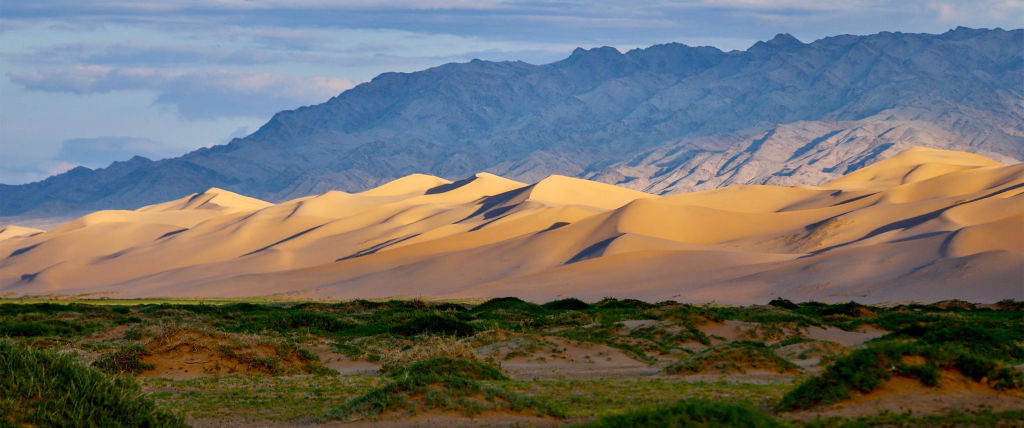
• Visit to the Khongor sand dunes. These dunes are the most spectacular in Mongolia, stretching over 110 miles long and 12 miles wide, with an average height of 264 feet, the highest reaching 396 feet. The view of the desert from their summit is truly breathtaking.
• Overnight stay with a nomadic family.
Jour 6
The Khongor Dunes18 km
Walk in the dunes
Free day
Option to ride a camel (additional fee)
Overnight stay with a nomadic family
Jour 7
The Khongor Dunes – Bayan Zag 180 km
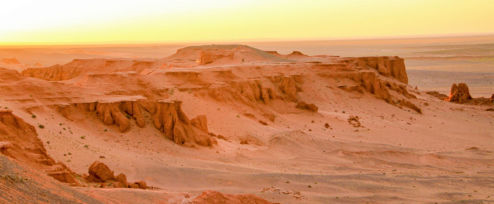
Visit the Bayanzag cliffs, better known today as the “flaming cliffs” due to their ochre and red hues, where the “dragon cemetery” is located. These cliffs, along with the surrounding saxaul forests, witnessed a time when the earth was still populated by gigantic creatures: dinosaurs. Paleontologist Roy Andrews Chapman was the first to discover dinosaur bones and eggs there in 1922, which can now be seen in the Natural History Museum in Ulaanbaatar and in many other museums around the world.
• Overnight stay in a tourist camp
Jour 8
Bayan Zag—the Ongi Monastery 180 km
• Visit to the monastery. This monastery was one of the largest and most respected in Mongolia before its destruction in 1939 by the communist authorities.
Today, a temple has been completely rebuilt and two small museums have been created in yurts. There are exhibitions of objects, traditional religious items, and architectural elements from the original monastery.
• Overnight stay in a tourist camp.
Jour 9
Ongiin Monastery – Karakorum 300 km
• Drive to Karakorum, the ancient capital of the Mongols. The legendary city of Genghis Khan was founded in 1220 and was one of the stops on the Silk Road. It was from this city that the Mongol Empire was ruled until Kublai Khan moved the capital to Beijing. Today, only a few remains of the capital city are left.
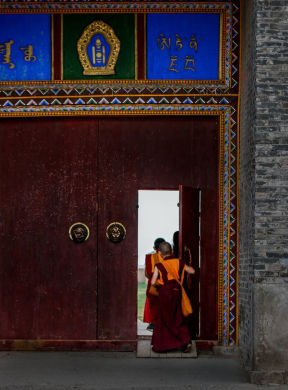
• Visit the magnificent Erdene Zuu monastery, built in 1586 by a nomadic prince. The buildings, inspired by Chinese and Tibetan architecture, are surrounded by 108 sacred stupas. Visit the Karakorum museum.
• Overnight stay in a tourist camp.
Jour 10
Karakorum – the Orkhon Valley 130 km
Route to the Orkhon Valley. Listed as a UNESCO World Heritage Site, the valley is a land of nomadism and many herders set up their summer camps there every year.
Night with the nomads
Jour 11
The Orkhon Valley100 km
• Visit the Ulan Tsutgalaan Falls, a white stream cascading over black rock, transformed by a ray of sunlight into a fleeting rainbow. These 16-meter waterfalls are simply magical! They were formed 20,000 years ago by a unique combination of earthquakes and volcanic eruptions.
• Stay with a family of nomadic herders in the valley. During your stay, you will discover the way of life of the inhabitants, and you will be offered many activities such as milking animals, making traditional dairy products, or gathering herds on horseback.
• Rest
• You will also watch the preparation of a Mongolian barbecue, which you will enjoy in the company of your hosts.
Jour 12
The Orkhon Valley – The Tsenkher Hot Spring 130 km
• Arrival at the Tsenkher hot springs, where you can relax in the camp's hot water baths.
• Overnight stay in a tourist camp.
Jour 13
Tsenkher Hot Spring - Terkh White Lake220 km
175 km on paved roads
45 km on trails
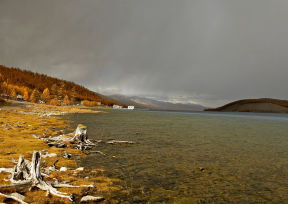
Horgo-Terkhiin-Tsagaan Nuur National Park is located in central Mongolia, in Arkhangai Province, in the village of Tariat. The park was established in 1965 to protect the unique landscapes of the northern Khangai Mountains and to conserve the rare plant and animal species that inhabit the region. Covering 77,267 hectares, the park includes mountains, basalt cliffs, lava valleys, crevasses, caves, lakes, and rivers. The park's main natural attractions are Lake Terhijn-Tsagaan Nuur and the extinct volcano Khorgo-uul. Lake Terkhiy-Tsagaan Nuur, which means Great White Lake in Mongolian, is located at an altitude of 2,060 meters above sea level, has an area of 61 square kilometers, and an average depth of 20 meters. Most of the year, the lake is covered with ice. In summer, it is possible to swim there, but even on hot days, the water in the reservoir is quite cold. Three kilometers east of the lake is an extinct volcano, Khorgo-uul, with a height of 2,240 meters. The volcano was active 8,000 years ago, and traces of its eruptions are still visible today—lava fields with crevasses and caves, basalt blocks, and molten rocks. The lava flows ejected from the mouth of the volcano blocked the Hoyd-Tarkhin-Gol River, giving rise to the Great White Lake. The volcano's crater has a diameter of 200 meters and a depth of 70 to 80 meters. You can climb to the top of Khorgo-uul via a path that winds along the slope of the volcano. Visitors can go trekking, swim in the lake, or fish.
Overnight at the tourist camp.
Jour 14
Lake Terkh12 km
Visit to the extinct Khorgo volcano
Free afternoon: opportunity to go horseback riding, fishing, walking around the lake, and hiking in the mountains
Overnight stay at the tourist camp
Jour 15
100% on the trail
Trails with mountains, passes, and hills in mountainous areas
Overnight stay at tourist camp
Jour 16
Shivert Mountain - Lake Khuvsgul 260 km
100 km on paved roads
160 km on dirt roads
Lake Khuvsgul - This is a large freshwater lake located in northern Mongolia, near the Russian border. It is the second largest and deepest lake in Mongolia. In terms of its origin, hydrological regime, and mineral composition, the lake is very similar to Lake Baikal, sometimes referred to as “Baikal's little brother.” Khuvsgul is a high mountain lake, located at an altitude of 1,646 m above sea level. Its water volume is 381 km³, and its maximum depth is 262 m. Khuvsgul is the deepest lake in Mongolia. The lake is 136 km long and 36.5 km wide at its widest point. There are 96 rivers and streams that flow into the lake. The Egiin-Gol River flows out of Khuvsgul. It freezes from December to May, and the ice can reach a thickness of 1.4 m. The ice begins to melt in May and finishes melting in early June. The water temperature varies between +10 and +14 °C. Khuvsgul's second name is the Blue Pearl. It is one of seventeen ancient lakes, more than 2 million years old. The lake region is a strictly protected national park, a transition zone between the Central Asian steppe and the Siberian taiga. The park is home to many wild species listed in the International Red Book: Siberian ibex, argali, elk, wolf, musk deer, brown bear, and sable. and the lake is home to nine species of fish (including lenok and grayling). Lake Khuvsgul is one of Mongolia's tourist attractions. The northern part of the lake is located 11 kilometers from the Russian-Mongolian border.
Overnight at the tourist camp.
Jour 17
Lake Khuvsgul - Murun 130 km
Morning:
Option to go for walks along the lake shore
Option to go kayaking or boating
Option to visit the Tsaatans (reindeer herders)
Afternoon: drive to Murun
Overnight stay at the tourist camp
Jour 18
Murun - Ulaanbaatar12+600 km
600km by plane
12 km by road
Domestic flight Murun - Ulaanbaatar
Opportunity to shop and visit the cashmere factory in Ulaanbaatar
Overnight stay at a hotel
Jour 19
Equestrian statues of Genghis Khan 130 km
Built in 2008, the 40-meter-high complex of equestrian statues of Genghis Khan (Chinggis Khan) in Tsonjun Boldog has quickly become one of Mongolia's must-see attractions. The imposing statue on the banks of the Tuul River, with Terelj National Park in the background, offers a majestic setting and a sight not to be missed.
Genghis Khan on horseback currently holds the record for the tallest equestrian statue in the world. Visitors can climb to the top of the horse's head to get a closer look at the khan himself and admire the beautiful landscape of Tsonjin Boldog and the Tuul River.
At the foot of the statue, you will find the visitor center, which houses a huge two-story traditional Mongolian boot, a 5-meter sword, an archaeological museum, a small souvenir shop, and a restaurant.
Jour 20
Last day50 km
Airport transfer
Included
Airport transfer
2 nights hotel accommodation in Ulaanbaatar
All meals during the trip in the countryside
The last dinner in Ulaanbaatar
All visits (museum, monastery…)
Yurt camp costs
Entrance fees to the national park
All road taxes
1 guide, 1 mechanic, 1 assistant
Motorbike rental, HONDA CRF 250L
Gasoline
Bottled water
Not included
Flight costs
Cost of the visa
Insurance
Meals in Ulaanbaatar